Showing posts with label Aric. Show all posts

Monday, June 27, 2011

cadaver dogs, Eating the tender thing that will not fill

Sorry I've been less than stellar about updating and participating. Our next serving of Loudon is “Eating the tender thing that will not fill”.

Remember that postmodern stutter? Let's take a look at an excerpt:

There are odd punishments afoot.
For instance, the time you ate
your brother after cooking him
in a port reduction and fatfatfat
no take-backs.

By my reading, the voice in the first line is curious and slightly dated. I'll call it fairytale-ish. In the second line the voice is controlled and explanatory. Then on the third, psychotic. The fourth line breaks down into that gibber. The fifth line completely regresses into a childishness that is playful, lacks conscience, and remains literally true (as far as there are no take-backs when you eat your brother).

I'm not saying Loudon is formulaic, not at all, but I find the general thrust of her language here to be familiar after only four poems. It's something I've been struggling to express so far.

On the whole I'm reading this poem as being about insatiability and carnal hunger. The language is primarily food (and prey) throughout, with a touch of aggressiveness, but I think my reading is very much supported at the end where the poem is written “you can hardly sleep from all the racket in your bed / and spring, yes, the spring market is near”.

Also, there's something elided. The poem is in numbered sections. 1, 2, 4, and 5.

Finally, a little journey in trying to understand the line “Mars hangs above you like a meat chime.”

First, I started by picturing Just the planet mars above you (me):


Then I associated Mars with the god of war, so now I'm picturing the idea as emblematic:


Well then I'm wondering what the hell a meat chime is. So I ask Janelo, she says she doesn't know, but pictures it as a chime (like a dinner chime) made of marbled meat. So this image is interesting. I combine it with the others:


So I'm thinking that it's a a bell made of meat, that's triggering aggression, like an astrological omen.

Well, at this point I start talking to Jake S, who you might know from the PFFA. And he tells me:

i wouldn't overanalyze
poetry is meant to be kept simple
simple and clear
i believe was wc williams dictum
i got taht from someone
5. she's food
so 1) food eating part hurts/injured
2) eating is punishment (brother?)
4) eating is war
i think this is a pro-vegetarian poem
honestly
your brother
could be like
"brother wolf"
my brother the owl
sort of native american ish

“Well,” I ask him, “what do you make of 'hardly sleep from all the racket in your bed'?”.

Jake: N is food
twine around her feet
her bed is a meat locker
sh is meat


Which I had to admit is a compelling reading. So I searched “Rebecca Loudon vegetarian” and came up with an interview and this excerpt:

Reb: You're a vegetarian yet you wrote a book called Cadaver Dogs. WTF? Are you being political? Are you judging me cause I eat steak?"

Rebecca: Do you eat puppies? I won’t judge you for eating steak but if you eat puppies, we may have to agree to disagree. People are frequently surprised and somewhat disappointed when they find that Cadaver Dogs is not a book of dead dog poems. Cadaver dogs are police dogs trained to detect human remains. On the surface, Cadaver Dogs consists of poems exploring the way animals, all animals, not just our family pets, affect our lives. If you peel away a few layers, you may or may not discover that Cadaver Dogs is a series of poems about the perils of being a child in a dangerous world. I recently told my therapist that I liked animals better than people. She said she wasn’t surprised, so I fired her. But the truth is, when I was a child, my dog never told me that I have trust issues. He just put his head on my lap and slobbered. And the cats that live with me now love every single poem I write and never judge the way I dress."

I do think Jake may be onto something with his reading. And, maybe, as he says:

Jake: yeah dude
so here's the thing
you were overanalyzing big time
for meaning


Well. It is a compelling argument. Whether or not my reading holds water, I thought you guys might find the process interesting.

Now I can sleep.

Friday, June 24, 2011

I’m awfully behind here, though it’s not for lack of reading her. I think I have trouble writing about Loudon in particular because her poems make me so uncomfortable. They’re not easy, in any sense of the word, for me.

First, she has a voice that I can only describe as a sharp, aggressive, obsessive post-modern stutter and when you read it sympathetically the sensation just isn’t pleasant. I find I have to live with that voice for a while too; the frenetic and sharp little phrases that clatter about, usually without punctuation to guide, force me to read and reread. The language and ideas are consistently nightmarish. Often violent, as in Dear Extinguished Individual:

point shoes clacking down the stairs
Molotov cocktail down the stairs
flat on my face as usual
rag wick showing

Though, I’m usually more unsettled by the more quietly nightmarish:

I sleepwalk now wake washing
my hands in the kitchen sink
green light

                                                       (& eels under the floor)


The parentheticals are scattered throughout, and at one point she uses them as a typographical gimmick:

MY VOICE GREW ))))))))


Which seems to be me at once a statement of preference for the poem’s appearance and form on the page and against the poem as vocal tradition. I don’t mean, by the way, that she neglects sonics. From my examples alone it should be clear that she pays attention to that, but it seems to me that a big part of what she’s doing is working with the expectation that you will be looking at and reading these poems on the printed page.

I know it seems like I’m being negative, but I guess that’s because reading this is a negative experience. It’s dark. I really admire how effective it is. I wish I could do what Loudon does.

Monday, June 20, 2011

cadaver dogs, don't you feel it's dangerous to want we're losing time hurry hurry

For Brown Dog, Poobah, Tom Dooley, Joe, Ginger, Teddy, Crazy Legs, Little Cat, Kelly, Bucket, Gideon, Baby, Ma, Smoky Joe, Fledge, Candy, Beethoven, Max Headroom, Pantages, Joe, Little out-of-the-wall, Simon, Shantie, Jeeves, Lloyd, Butch, Daphne, Zoe, Duncan, Buddy, Thelma, Megan, Winky, Klöie, Ophelia, Lars, Cruiser, Yogi, Bantu, Paris the Genius Cat and Orlando


That's from the apparent dedication to the book, and I think we can assume these are all pets. I'm including it now just in case it's relevant in future poems.

The title immediately brings to me the language of infomercials, oddly, but I'm also reminded of Eliot's "HURRY UP PLEASE IT'S TIME" from The Wasteland. I didn't get anything further out of that association though, it just made me think of it.

Anyway, not to lean too heavily on the title, the larger theme here seems to be danger and desire. Let me go ahead and bring up the dedication above, and this quote from the end of the poem:

paris the genius cat is in the yard stalking the bird
his heart clapping so fast
it's become                                               its own animal.


I think that I can take this to mean that Loudon may be the actual narrator of this poem. If so, it's further autobiographical in that she brings up one of her ex-husbands (my second husband whose name I stole / he of the golden body hair quiet as a pet).

Also, lets not ignore that remarkable last line.

I don't have much to say about the meaning of the poem, I think it's just danger and desire, as I said, but what's remarkable here is how she arranges this with such a collage of suggestive and horrific imagery. I do mean horror. Here:

my house drowns
I crawl naked toward you on the floor
white and dark meat the dark
full of blood


Thank you, Rebecca. I think I'll go watch Naked Lunch and eat spaghetti for dinner now.

Thursday, June 16, 2011

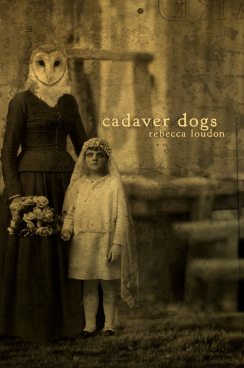
cadaver dogs, Rebecca Loudon


It was tough to choose as I have more than a few unread books by contemporary poets, but ultimately I decided to go with cadaver dogs by Rebecca Loudon because, well, that was the next book I wanted to read.

A flip-through tells me that I'm in over my head here because I'm not sure what the poems I've read in there mean. In fact, it wasn't until I started research for this description that I found out that "cadaver dogs" are police dogs that are trained to sniff out decomposing human flesh. Between that factoid and the cover I think we can expect some dark material.

The first poem is titled "Double-plush Wolf in a Hungry Age". The close proximity of Hungry and Wolf led me to expect a fairy-tale motif, and I think that I found it mixed in with some production/consumerism and general sexual identity. Of course I'm thinking "Little Red Riding Hood", and generally that's understood to be about sex or rape. I think this strophe supports that reading:

A bit of fur glued on and some fork tines
and my transformation was complete. I was
the little man in the brown suit your mother
warned you about.


This fairy-tale language seems to be a large part of the poem, including "enchantments", sleeping children, and a notable "nibble nibble nibble / the center of your sweetbread heart." (which always reminds me of Hansel and Gretel).

If there's a narrative in the poem, it's lost on me. There's a declarative "I am a seamstress" in the fifth line, so I did get a sense of a single, clear narrator, at least, but I don't know that she's meant to tell a story.

I do feel there is some message or sense of consumerism intentionally worked into the poem. It starts with a very suggestive enjambment on the first line:

A wax snout is a lot of work for a city
girl living in the forest, even counting


And language pops up like "5 Mile Prairie" and "Betty Crocker Potato Buds". I think the title itself refers to consumer culture by "Hungry Age".

I may just be disorganized tonight, but I do think the poem resists a purely rational explanation. I think a large part of the poem is the impression the words and (startling) images leave on the reader. It is disconcerting, over all.